
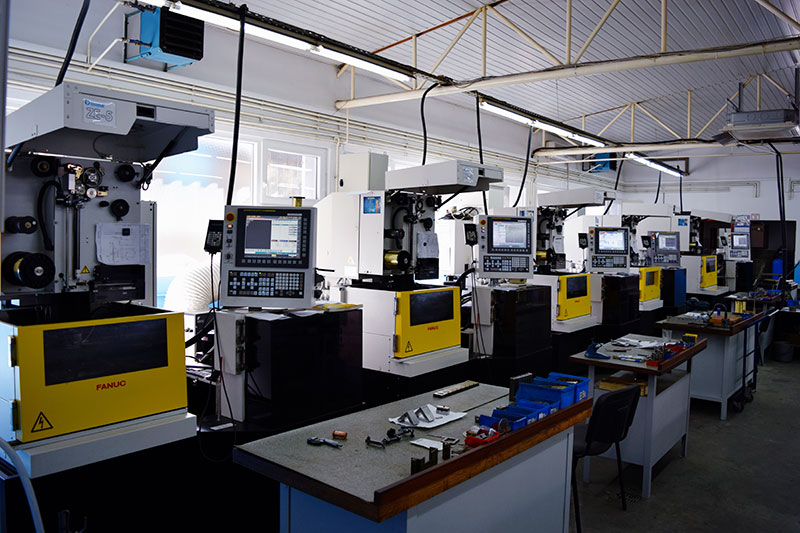
In precision industries, where microns determine success, Wire erosion technology (EDM) occupies a special place. Unlike traditional metal processing methods, eroding machines allow for shaping materials without physical contact, thus achieving a high level of precision and preserving the integrity of the workpiece.
This article reveals the key advantages of wire erosion which are particularly important in industries such as toolmaking, aeronautics, medicine, and automotive manufacturing.
Non-contact machining: no material stress
In conventional metal machining, the tool mechanically enters the material and creates pressure which often causes deformation, vibration, or even micro-cracks in the workpiece. In wire erosion, this contact does not exist – the wire never touches the material itself. Instead, electrical impulses between the wire and the workpiece cause micro-explosions which precisely remove material layer by layer.
This method of operation is particularly useful for parts that require absolute dimensional stability and for materials that would easily deform under mechanical stress, such as thin parts, hardened steels, and complex contours. Erosion also eliminates the need for subsequent straightening, which further saves time and resources.
Exceptional precision and repeatability down to the micron level
One of the most highly-valued characteristics of EDM technology is its ability to achieve extreme precision. Under controlled conditions and with a good technical drawing, an EDM machine can process a part with tolerances of less than ±2 microns. This is a level of precision that is practically unattainable for most conventional machining methods.
In addition to the precision of individual parts, EDM also guarantees a high level of repeatability. In series production, each part will have identical dimensions – with no fluctuations, no deviations. This is of crucial importance for all sectors where the reliability and compatibility of parts are imperative, such as the medical and aerospace industries.
Machining of the hardest alloys and difficult-to-machine metals
Traditional metal processing methods face limitations when it comes to hard materials. Milling cutters wear out quickly, the tool vibrates, and machining becomes inefficient or even impossible. This is not the case with wire erosion. EDM does not rely on mechanical force – only electrical conductivity is sufficient.
This means that materials such as carbide, titanium, Inconel alloys, tool steels hardened to over 6 HRC, and even exotic alloys can be processed without any issues. There is no need for pre-annealing or softening of materials. The process remains stable, the tool does not wear, and the surface quality is consistent and smooth.
Complex geometries and internal contours – without tool limitations
One of the biggest challenges with traditional machining is accessibility – a tool simply cannot get into every corner. A milling cutter has a diameter, a drill bit has a length, and any change of direction means a change of strategy and additional machining. Wire EDM overcomes this. A thin wire can follow a complex path through the material, including inside corners, narrow slots and multiple planes in a single pass.
Thanks to CNC control, it is possible to perform tapered cuts, multiple contours at different heights, as well as precise internal details that would otherwise require multiple machining operations. This makes EDM indispensable in toolmaking, the manufacture of electrodes, moulds, and precision components that require freedom in design.
Less waste material and minimal post-process machining.
The key to efficiency in any manufacturing process is the reduction of waste and processing time. With EDM, material is removed precisely where it is needed – with no rough transitions, no need for final grinding, and an exceptionally smooth surface. This means the finished part can often be used immediately, without any additional mechanical machining.
Also, the precision of the cut means there are no multiple attempts to „hit the tolerance“, which significantly reduces the cost per part. Given that wire erosion does not wear tools in the same way as conventional methods, there are also savings on consumables. All this makes EDM economically viable for both smaller batches and prototypes.
Conclusion
When precision is not just an advantage but an obligation, wire erosion is the technology that delivers results. It enables perfectly clean edges, micron-level machining, reliable repeatability, and the machining of materials that conventional tools simply cannot handle.
In industries that demand perfection – from aircraft parts and medical implants to mass-production tools – the Erozimat is more than a machine. It is a tool of trust.