
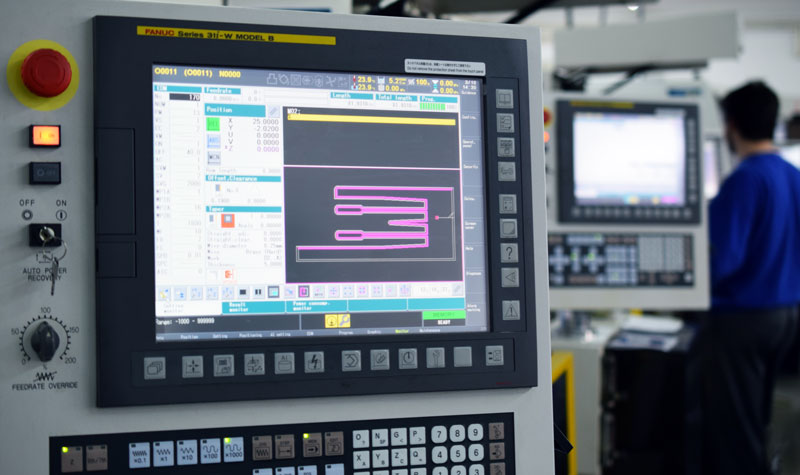
Wire erosion, also known as EDM (Electrical Discharge Machining), is a metal processing technology using electrical discharges. Unlike conventional methods such as milling or turning, there is no physical contact between the tool and the material.
Instead, the material is removed by a spark created between a thin wire and a workpiece, immersed in a dielectric liquid.
This method is irreplaceable when dealing with extremely hard materials, demanding geometry and micro-precision.
How Erosimat works: A quick look inside the machine
Aerozimat uses a thin wire (most often made of brass or molybdenum), which is continuously moved between two spools. The workpiece is placed in a bath full of dielectric fluid – usually deionized water. When a small enough gap is formed between the wire and the material, an electric discharge occurs that locally "melts and blows out" small parts of the material.
Advanced controllers enable extremely precise management of this process, often down to tolerances of less than 0.01 mm.
What materials can be processed by wire erosion?
The main advantage of EDM technology is that it can also process materials that are difficult or almost impossible to process with traditional tools. These include:
-
Hardened tool steels
-
Tungsten carbide (vidia)
-
Titanium
-
Inconel and other superalloys
-
Copper and brass
-
Conductive aluminums
The only condition: the material must be electrically conductive.
What geometries and precisions does EDM processing allow?
Thanks to its "non-contact" nature, wire erosion enables processing of the most complex contours, very tight corners and precise details. Some of the typical features include:
-
Angled edges (beveling)
-
Thin slits and openings
-
Micro parts with high precision
-
Smooth surfaces without mechanical stress
EDM is often the only option when looking for a combination: hard material + complex form + micron level of precision.
The main advantages of wire erosion compared to classical milling
At first glance, wire erosion and CNC milling have a similar goal - precise metal shaping. However, the approach is completely different. In milling, the tool physically penetrates the material and removes layers by mechanical force. In EDM machining, the shape is achieved by series of electrical discharges, without contact with the tool.
This opens up a whole range of possibilities, especially when it comes to hard materials or parts with complex geometries.
Let's look at the main differences:
| Characteristic | Wire erosion | Milling / Turning |
|---|---|---|
| Contact with the material | None | There is |
| Processing of hard materials | Yes | Limited |
| Accuracy | Very high (up to ±2µm) | Good (depends on the machine) |
| Material stress | None | There is |
| Shaped cuts | Yes, and at an angle. | More difficult to do |
Although wire erosion cannot always replace classical methods, its importance is enormous when it comes to the requirements for micron-precision, minimal material stress and geometries that cannot otherwise be obtained mechanically.
In practice, it is most often used as milling supplement - finishing of complex areas or processing of parts that would otherwise be deformed by mechanical contact. In short: where the milling machine stops, The erosimat is starting to shine..
In which industries are erosimates used?
Due to its reliability and precision, EDM is used in sectors where accuracy and reliability are critical:
-
Toolmaking: mold and tool production
-
Aerospace industry: processing of alloys that endure extreme conditions
-
Medicine: manufacturing of implants and precision instruments
-
Automotive industry: complex engine and transmission parts
-
Electronics: micro parts for connectors and housings
Whether it's prototyping, replacing a key part of a tool, or mass-producing high-precision components, wire erosion finds its place where other technologies stop. Its precision, ability to process demanding materials and stable reproducibility make it an indispensable tool of modern production.
If you work in an industry where millimeters are crucial, and every mistake is expensive - it's worth considering making erosimat a part of your process.
Is wire erosion the right technology for your part?
If you work with hard materials, have parts that require high precision, or need to machine delicate geometry - wire erosion is probably the best choice.
But it is also important to know its limitations: the processing speed is slower compared to milling, and the cost can be higher for simpler geometries that can be produced by traditional methods.
Recommendation: consult the EDM machine operator already in the stage of designing the work.