
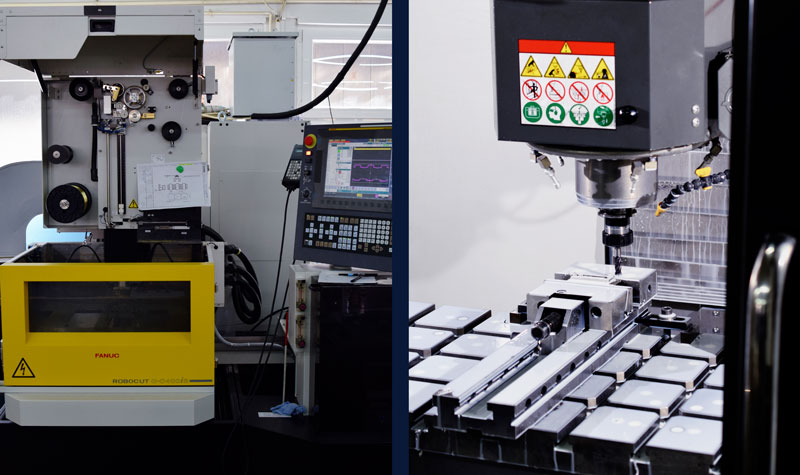
In the world of precision metal machining, the choice between wire erosion (EDM) and CNC milling can make the difference between a successful project and costly corrections. While both methods have the same ultimate purpose – shaping metal into precisely defined geometries – the way they achieve this is entirely different. Below, we present a clear comparison to help you choose the right technology for your needs.
How EDM and CNC Milling Work: A Brief Comparison of Operating Principles
CNC milling uses rotating tools that mechanically remove material from a workpiece. Wire erosion, on the other hand, uses electrical sparks between a wire and the material to gradually remove metal. This fundamental difference means EDM makes no physical contact with the material, making it suitable for extremely hard and brittle materials. CNC milling is much faster for roughing operations but can struggle with very narrow contours or sharp internal corners. EDM is ideal for tasks where high precision and intricate geometry are required.
Materials: Which technologies master which alloys?
CNC milling is extremely effective on aluminium, soft steels and plastics. However, for materials that are hard, abrasive or difficult to machine – such as hardened steel, titanium or carbide – EDM takes precedence. As it does not use contact force, EDM can also be used for machining tasks on materials that would otherwise fracture or deform under conventional milling. It is important to understand a material's heat resistance, electrical conductivity and the required surface finish when choosing a method.
Geometry and tolerance: When you need a micron, and when speed
For exceptionally precise contours, internal openings, and sharp internal corners, EDM is second to none. The wire can be guided so precisely that it allows for tolerances in the micron range. Milling, on the other hand, allows for higher speeds but has limitations when it comes to accessing complex areas. If the project is time-sensitive and does not require ultimate precision, CNC milling is likely the more cost-effective option. When it comes to high-requirement finishing - EDM takes centre stage.
Productivity and cost: Where does the real profitability lie?
At first glance, CNC milling appears more economical due to faster processing. However, the costs of tooling, cooling, replacement parts, and potential errors that can arise from vibrations or loads must be considered. EDM has higher energy requirements and a slower process, but it requires less manual intervention and virtually eliminates errors. In the production of small batches and for highly complex parts, EDM can even prove to be more efficient – especially when the cost of an error can outweigh the time savings.
Combining EDM and CNC in Real-World Projects: The Best of Both Worlds
Many manufacturers combine both methods to optimise both speed and precision. For example, rough material removal is carried out by milling, and then EDM is used for finishing detailed contours. Such a combination allows for maximum efficiency, especially in the production of tools, moulds, and complex mechanical components. For complex parts, this strategy reduces processing time and increases accuracy without the need for additional calibration or rework.
Conclusion: How to make a good decision?
The choice between wire erosion and CNC milling depends on several factors: geometry, materials, tolerances, timeframes, and budget. There is no universal solution, but understanding the strengths and limitations of both technologies helps in making a decision that is technically and financially sound. In some cases, the best solution is a combination of both – the speed of one and the precision of the other. Smart machining doesn't just depend on equipment, but on knowing when and how to apply it.